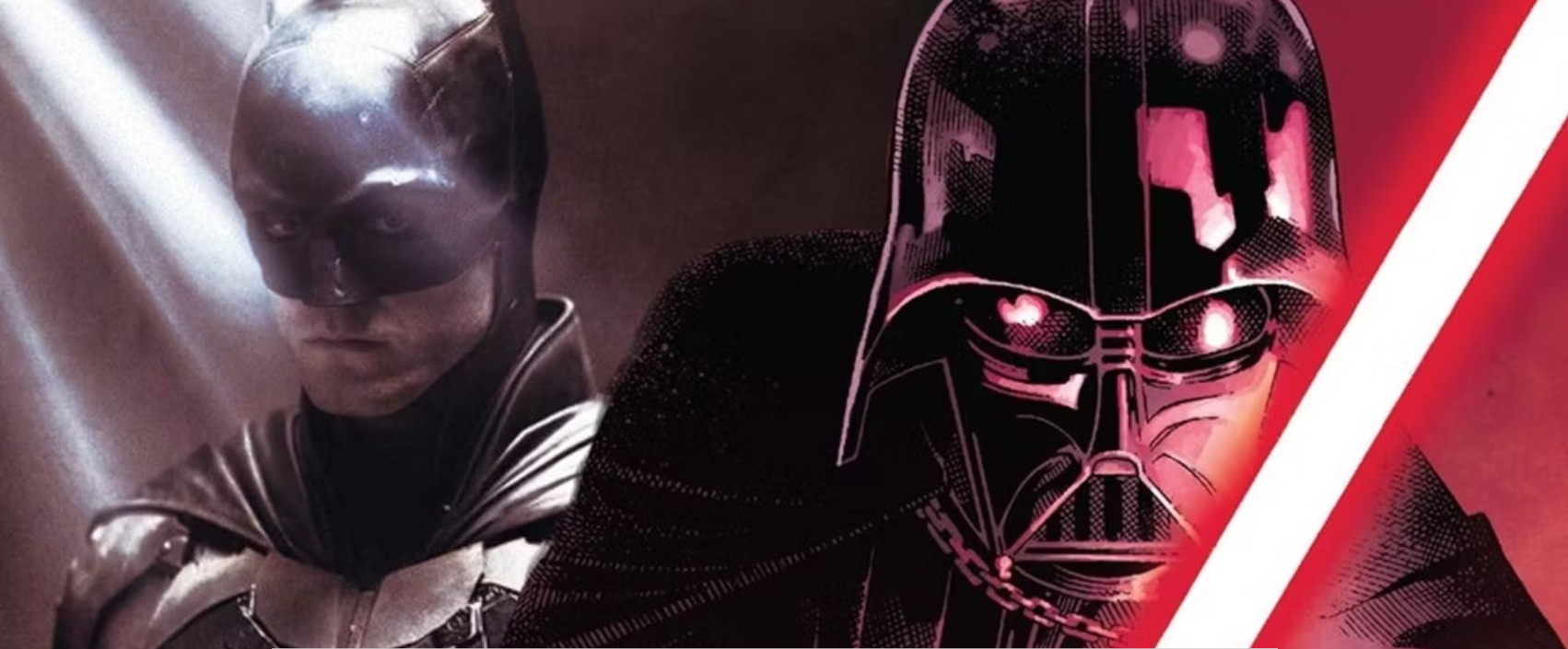
Both Bruce Wayne and Anakin Skywalker expose themselves to their respective fears, a fictional illustration of the real-life psychological therapy called self-exposure.
In The Dark Knight, Bruce returns to the genesis of his fear of bats—the water well—and stands firm against the onslaught of flying bats. His stance is symbolic in that he rises from a crouching position—representative of a scared child—and into a standing position in which he opens his arms, closes his eyes, and seems to invite the permeation of the bats into his very being. Even the bottom of the well provides an image of psychological darkness, as Nolan places Bruce in a dark, cave-like setting, perhaps an echo of dark scenes written by previous gothic giants Edgar Allan Poe and Charles Brockden Brown. Similarly, Anakin exposes himself to the fear of losing Padme, but his exposure does nothing to assuage that fear as it does for Bruce Wayne. Instead, Anakin purposely senses the future by putting himself in touch with the Force. He chooses to add to his mounting fear and anxiety by seeing and hearing things that relate to Padme’s death. After hearing Palaptine’s voice say through his connection to the Force, “You do know that if [the Jedi] kill me any chance of saving [Padme] will be lost,” he asks her, “Obi-Wan’s been here, hasn’t he?” (Lucas). This question seems innocent enough to Padme, but the audience can sense in Anakin’s tone that he suspects Obi-Wan—and therefore the entire Jedi—simply because his master has “been here.” This exposure is very different from that of Bruce Wayne; for Anakin, it only heightens his anxiety and further distorts his sense of reality, and it is this distortion that will eventually allow Palpatine to convince Anakin of the Jedi’s treachery, albeit a false one. Unfortunately for Anakin and the galaxy, he does not face his fear in a healthy way like Bruce Wayne does; instead he faces it as simply a way to convince himself that the Jedi are out to get him.
Once Palpatine equates the Sith and Jedi in Anakin’s mind and makes Padme the only controlling factor in Anakin’s behavior, it is easy for the young Jedi knight to choose his love for Padme in the compromising situation he puts himself in.
This situation is exactly what Bruce Wayne aims to avoid by rejecting Rachel’s love and any hope of stability with her in the Batman story. Similar to Peter Parker’s and Harry Potter’s respective rejections of the love interests in two other hero stories, Bruce Wayne knows that in order to play the role of hero, especially a great one in an archetypal super hero saga, one must sacrifice the joys of a romantic relationship for the greater good of his mission. As true hero, Bruce also knows that his enemies are likely to use Rachel against him to try to make him compromise his values concerning his protection of the people of Gotham, which in fact the Joker does when he forces Batman to choose between the lives of D. A. Harvey Dent and Rachel. Batman even asserts the choice of the situation when he tells Harvey, “What happened to Rachel wasn’t by chance. We decided to act” (Nolan). It is for this reason that in Star Wars the Jedi code prohibits marriage, even falling in love, for any Jedi. Wisdom through the ages has made it clear that the security provided by the Jedi must come at a price. That price is that the individuals who choose the route of heroism in the Jedi order must not ever be involved with a woman, something Batman understands and abides by, albeit grudgingly and sometimes inconsistently. Anakin, of course, does not have the galaxy’s best interest in mind as Batman does for Gotham; he is not willing to make that sacrifice, even showing his arrogance when he says to Padme, “I don’t care if they know we’re married” (Lucas). His love for Padme and his refusal to follow the Jedi, indeed the archetypal heroic, code precipitate the galaxy’s collapse into moral darkness, a fate that might have been Gotham’s had Batman been equally selfish.