(Editor’s Note: This is a guest post from 17-year-old student writer “Arthur Kirkland″ in Jeff LeJeune’s English 102 course, 28 March 2024. Some liberties have been taken with paragraph breakage to more fit the blog model))
It is a pleasure to burn for far too many, and we should all care a little more about that.
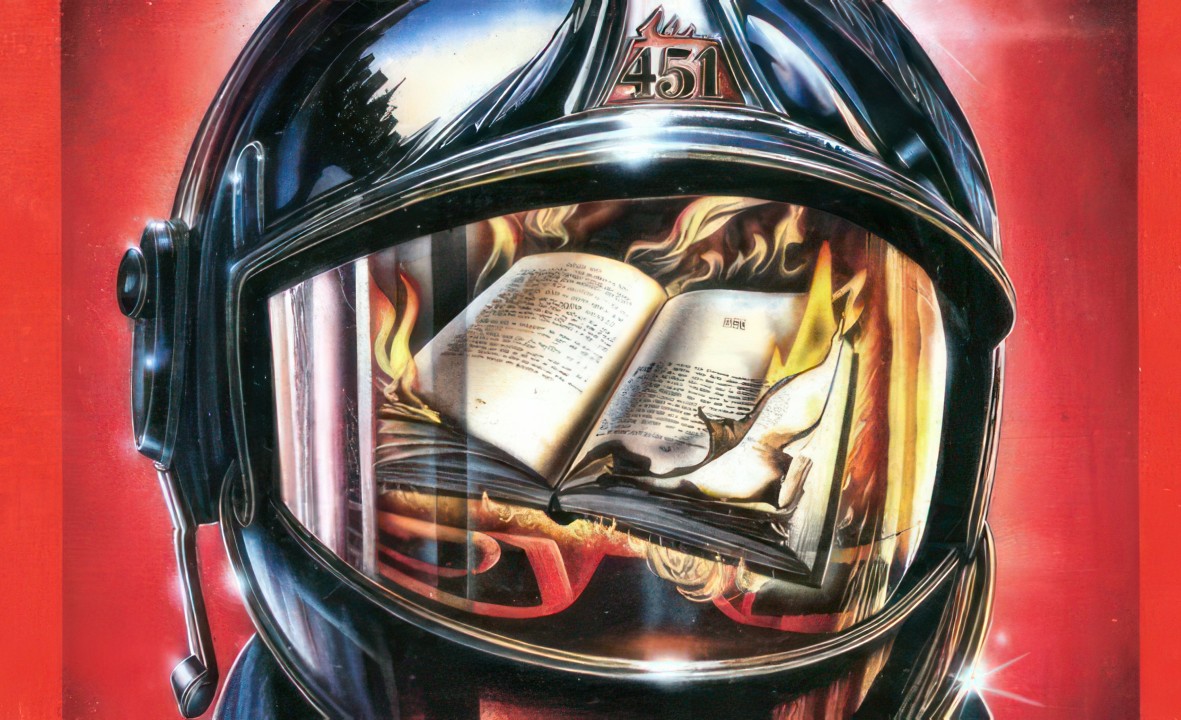
Although the works of Ray Bradbury are often overlooked and he is often accused of not producing “anything of importance” (Hamblen 818), it is almost unanimously agreed that Fahrenheit 451–his dystopian novel that stands out from the rest of his science fiction–is one of the greatest works in literature to date. In this novel, Bradbury depicts a complacent society where books are illegal and burned, intellectual discourse is discouraged, and the media provides a blissful nirvana to those seeking to escape their everyday struggles. This platform of ideologies is supported not only by government censorship but more importantly by the people’s docile nature and willingness to be manipulated. Although this book was written almost eighty years ago, Bradbury managed to almost perfectly depict the society we live in today as well as the society we are heading towards tomorrow.
The parallels between the book and our society concerning censorship and conformity of the people are finally starting to align and make themselves known.
Bradbury, through cynical and almost misanthropic satire as well as bitter irony, imposes the idea that these means of oppression must first be self-imposed by an ignorant society before it can be sanctioned by a tyrannical government. Captain Beatty, the morally ambiguous antagonist who maintains “order” in his society, is Bradbury’s medium to express this sentiment. In his monologue to Montag, the equally morally ambiguous bystander hero who becomes disenchanted with his life as a blissful fireman, Beatty explains that “it didn’t come from the Government down. There was no dictum, no declaration, no censorship, to start with, no! Technology, mass exploitation, and minority pressure carried the trick, thank God” (Bradbury 58).
In similar fashion, Faber, the figure who aided Montag in his search for truth, goes on to indicate that censorship was rarely necessary by saying “[r]emember, the firemen are rarely necessary. The public itself stopped reading of its own accord” (83). Both Beatty and Faber, in their most iconic quotes in the book, deliver to Montag the dismal epiphany that society, in their desire to be anesthetized, did this to themselves rather than government intervention which, by then, was seldom necessary. Hamblen also supports this idea presented by Beatty and Faber by saying “[a]utomation completed the trek to total non-intellectuality. Censorship was almost an afterthought, merely established to stifle those few, stubborn, philosophical souls who occasionally cropped up” (819). Here, Hamblen describes the oppression seen in the novel as automatic and declares that the need for censorship by the government is trivial as the people have done it themselves. It is this same willingness to “outlaw original thought” (Hamblen 819) and allow ourselves to be controlled through various means that are currently plaguing our society.
Much like our world today, the dystopia depicted in Fahrenheit 451 started with people agreeing as a society to blacklist those who dared to speak out against the mob. It is this desire to suspend someone’s rights for not agreeing with the subjective absurdity of mob rule that will eventually be the first nail in the coffin for a long reign of both social and political silencing. In a quote that is chillingly accurate to our current situation with cancel culture to the point where it seems to be a direct commentary on it, Beatty says, “[c]olored people don’t like Little Black Sambo. Burn it. White people don’t feel good about Uncle Tom’s Cabin. Burn it. Someone’s written a book on tobacco and cancer of the lungs? The cigarette people are weeping? Burn the book” (Bradbury 59). Once again, Beatty explains to Montag that it started with people being offended by literature and subsequently uniting to cancel it. If this sounds familiar, it is clear that despite this novel being written nearly a century ago, Bradbury has shockingly delineated our current society to a perfect parallel. Washburn supports this idea of Bradbury predicting the trajectory of our civilization by calling Fahrenheit 451
nothing less than a vivid depiction of what is going on around us, in an era when certain ideologies that purported to liberate people from the narrow confines of one or another identity have done the complete opposite and have forced a guilt-driven reckoning with the past, at least as ideologues see it.
He even goes as far as to humorously call it “one of the most trenchant iterations of ‘Told you so!’ in literary history.” It is because of these unbelievable parallels that are blatantly apparent to anyone with the slightest hint of common sense–a rare commodity now–that I believe that similar to Montag, the people must wake up to the tyranny that is currently on the rise in our society.
Despite the seemingly grim future illustrated so boldly in the novel, I believe that some people are indeed waking up, albeit slowly.
Ironically, and maybe providentially, Fahrenheit 451–a precautionary commentary on censorship–has been subject to an irate barrage of censorship throughout the years. In a humorously ironic anecdote, John Oster, a junior high school teacher, recalls an account in which he and his students read two different versions of the book to discover that some words have been omitted. He says, “[i]n addition to removing profanity (and certain references to god), the purgers also changed words: hangover became headache, and wild party was simply party” (Oster 11). Acknowledging the ridiculous irony of the situation, he even adds a satirical quip by telling his students “if they ever forget the meaning of irony, just think back to this situation” (Oster 11).
It is only by these smaller epiphanies that we can have a great awakening to the tyranny we have succumbed to. Now in classrooms, Bradbury’s novel is being used to teach censorship in order to wake the masses starting with the youth. Reviewing a Fahrenheit 451 curriculum being used in schools, Ebbers comments, “[s]tudents brainstorm for definitions of the word ‘censor’ and explore possible reasons for censorship” and even learn about past occurrences of censorship–both politically and socially–such as the McCarthyism movement. This information is arguably more than what most adults know. The best way to change the course of a doomed society is to start from the bottom with the future generations of America and work your way up; however, as Granger, the leader of an intellectual rebellion in Fahrenheit 451, advises, “you can’t make people listen. They have to come round in their own time, wondering what happened and why the world blew up under them” (Bradbury 136).
Despite the daunting beast that is cancel culture and nationally glorified censorship running rampant–even ironically censoring the book about censoring books–it is apparent that a small percentage of the population is indeed waking up to the tomfoolery of socially sanctioned cancel culture. The Montags of our society are becoming disenchanted with the mob and promoting free speech. It is because of Bradbury’s almost prophetic interpretation of a seemingly far-fetched society in which firemen start fires rather than extinguish them that the people may see past the illusion of ignorant bliss. If the rest of society fails to do the same, it is almost guaranteed that the right to speech, freedom of the press, protest, and religion will be imminently disenfranchised and repudiated. As Bradbury puts it, “[w]e need to be really bothered once in a while” (52) in order to wake up to the audacious attempts to suppress the free. The metaphorical guillotine to our free speech isn’t with the government but with our poorly misguided docility and willingness to be controlled. To remedy this, however, people would have to actually care.
Works Cited
Bradbury, Ray. Fahrenheit 451. Simon & Schuster Paperbacks, 1951.
Ebbers, Frances. “Review: A Unit on ‘Fahrenheit 451’ That Uses Cooperative Learning.” The English Journal, vol. 80, no. 6, 1991, pp. 100-1. JSTOR https://doi-org.mcneese.idm.oclc.org/10.2307/818594. Accessed 13 March 2024.
Hamblen, Charles. “Bradbury’s ‘Fahrenheit 451’ in the Classroom.” The English Journal, vol. 57, no. 6, 1968, pp. 818-19. JSTOR https://doi-org.mcneese.idm.oclc.org/10.2307/812029. Accessed 13 March 2024.
Oster, John. “Censorship.” The English Journal, vol. 86, no. 4, 1997, pp. 11. JSTOR https://doi-org.mcneese.idm.oclc.org/10.2307/820978. Accessed 13 March 2024.
Washburn, Michael. “We’re all living in ‘Fahrenheit 451.’” Book and Film Globe. 27 October 2021, https://bookandfilmglobe.com/fiction/were-all-living-in-fahrenheit-451/. Accessed 13 March 2024.