
(Editor’s Note: This is a guest post from 17-year-old student writer “hummingbird06″ in Jeff LeJeune’s English 102 course, 6 April 2023. Some liberties have been taken with paragraph breakage to more fit the blog model).
Google defines beauty as “a combination of qualities, such as shape, color, or form, that pleases the aesthetic senses, especially sight.” In today’s society, these pleasing qualities may be considered a necessity for most women, as they are consistently told that they must look a certain way in order to meet the societal “standards.” These standards, which truly have become requirements, are basically forced onto not only grown women, but young children as well. From an extremely young age, it is implanted into a young girl’s mind that they must look a certain way.
Barbie and The Little Mermaid, which are wildly popular amongst young girls, seem to be some of the worst influences for these children because they push concepts that can be detrimental to a young girl’s idea of beauty.
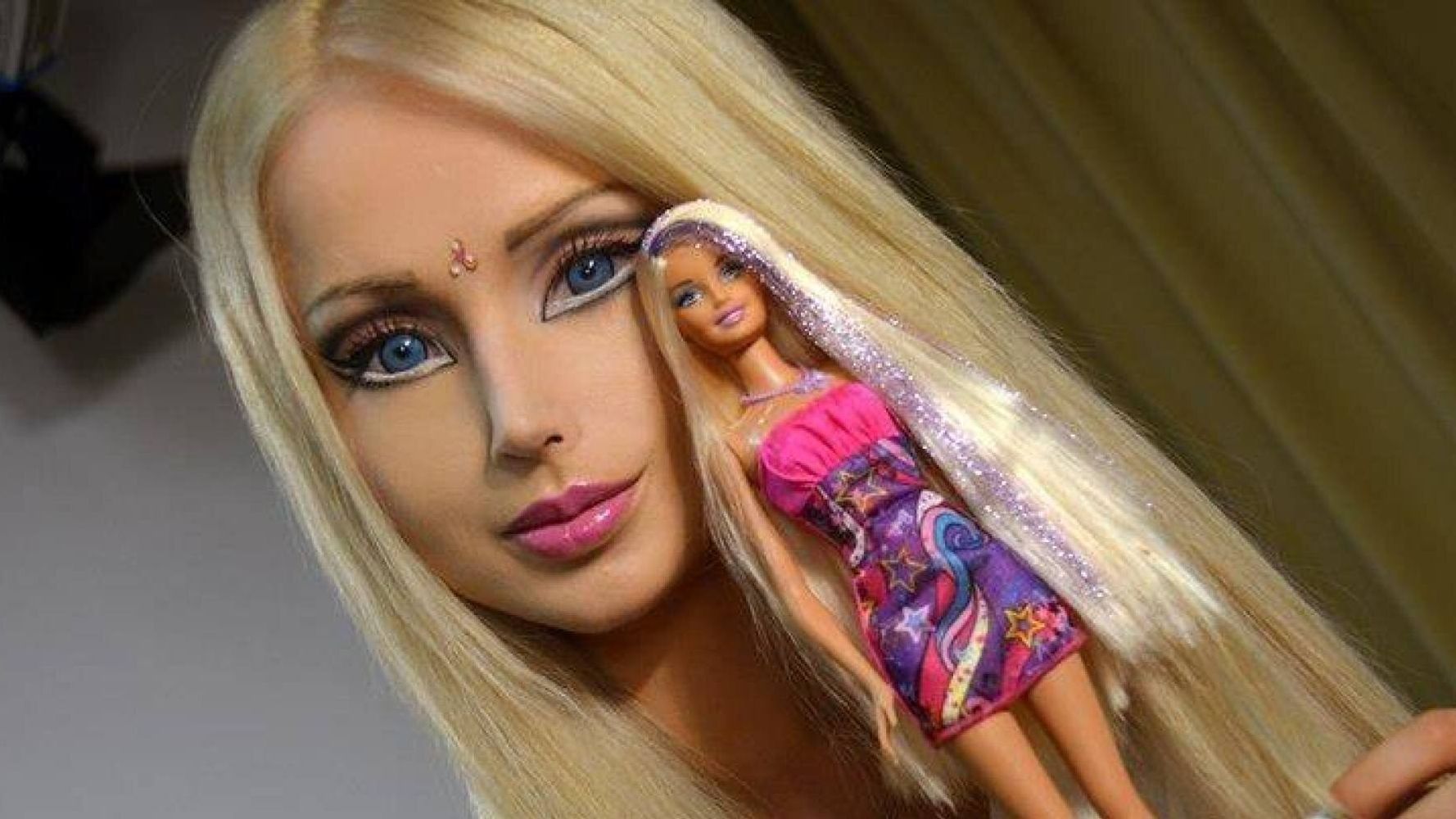
Barbie, a doll designed for young girls, may be one of the leading causes for body dysmorphia because she is the figure which society bases beauty on. This doll is extremely unproportionable; it is nearly impossible to achieve her look without medical intervention. Because they have been brainwashed by these toys, “young girls have demonstrated higher social comparative tendencies,” constantly wanting to change their appearance (Nesbitt et al. 2). One woman, Valeria Lukyanova, fell into the trap that these dolls have created.

Valeria has modified her appearance so severely that she truly does look like a doll, plastic and fake. To achieve this human Barbie look, she is following a “breatharian lifestyle” which is “a cult that believes food – and possibly water – are not necessary for life” (Cliff). Clearly, this “innocent” doll has caused her to “engage in appearance and body-related social comparisons as [she] matured” (Nesbitt et al. 13). This just goes to show how vulnerable not only women, but also children can be when exposed to such levels of indoctrination. This doll continues to weasel its way into women’s lives even after they have grown out of that Barbie phase that far too many young girls go through.
Similarly, The Little Mermaid is a Disney movie in which the main character, Ariel, must change her appearance entirely in order for the Prince to love her, potentially causing young viewers to think that this is necessary in real life. In the movie, the evil character–Ursula–convinces Ariel that “the only way to get what [she] wants is to become a human” (The Little Mermaid 30:57). In this situation, Ursula is comparable to the media in today’s society, convincing women that they must change their appearance in order to abide by its standards, just as Valeria alters her entire appearance in an effort to fit the societal model known as Barbie.
Ursula tells Ariel that she still has her “looks, pretty face, and body language” and wouldn’t need it, which is the whole reason that the Prince wanted her in the first place (The Little Mermaid 43:16). Even though she has given up her voice and tail for this Prince, he was still tempted to marry another woman because Ariel could not speak to him. Disney downplays the situation with Ariel “by pretending that everything is so sweet, so saccharine, so without any conflict,” when in reality they are showing young girls that they must lose, or change, their most valuable traits in order to be loved by a man (Hastings).
Like this situation with Ariel, young girls and women changing their appearance in order to look like Barbie does not seem to be a concern to many people because it has become the norm. This only makes insecurities worse for many young girls because society will likely never be satisfied with their appearance. While The Little Mermaid never directly states it, they are encouraging young females to change their appearance for not only society, but to please men as well.
It is one reason it is so important for children to have strong father figures so they are not spending their lives searching for love in all the wrong places.
Children, young girls, are being brainwashed and manipulated by toys and movies marketed especially to them. Such psychosis tells them they should change how they look or else lose certain qualities in order to be seen as beautiful or equal by the rest of society. Barbie and The Little Mermaid are just two of the many negative influences that a young girl may face on her laborious journey of growing up and learning to love herself, a clear reason why so many of them grow up to be shells of what they could have been.
—
Works Cited
Cliff, Martha. “’I haven’t changed since I was 14′: Woman dubbed the Human Barbie denies having surgery – saying her ‘classy’ look takes her an hour-and-a-half to perfect.” DailyMail.com, 30 June 2016, https://www.dailymail.co.uk/femail/article-3667523/Woman-dubbed-Human-Barbie-denies-having-surgery.html. Accessed 20 Mar. 2023.
Hastings, A. Waller. “Moral Simplification in Disney’s The Little Mermaid.” The Lion and the Unicorn, vol. 17, no. 1, June 1993, https://muse.jhu.edu/pub/1/article/244508/pdf. Accessed 20 Mar. 2023.
Nesbitt, Amy, et al. “Barbie’s new look: Exploring cognitive body representation among female children and adolescents.” PLoS ONE, vol. 14, no. 6, 2019, pp. 1-18. Directory of Open Access Journals, https://10.1371/journal.pone.0218315.
The Little Mermaid. Directed by John Musker and Ron Clements, produced by Howard Ashman and John Musker. Walt Disney Pictures, 1989. Disney Plus.




One response to “SKINNY MINI: How Toys, Movies Impact Women’s Self-Esteem”
[…] SKINNY MINI: How Toys, Movies Impact Women’s Self-Esteem […]